Technology QLS
Light-Sheet Fluorescence Microscopy (LSFM) or Selective Plane Illumination Microscopy (SPIM) is widely recognized for its gentle illumination, high imaging speed, and excellent lateral resolution. By illuminating the sample with a thin sheet of light orthogonal to the detection axis, SPIM minimizes photobleaching and enables rapid volumetric imaging of large biological specimens.
However, despite its strengths, conventional single-view SPIM suffers from a fundamental limitation: anisotropic spatial resolution. While the lateral (x–y) resolution is primarily defined by the numerical aperture of the detection objective and can reach sub-micron values, the axial (z) resolution is significantly poorer. As a result, fine structures appear stretched or blurred in the axial direction.
Multi-Angle SPIM: Improving Axial Resolution
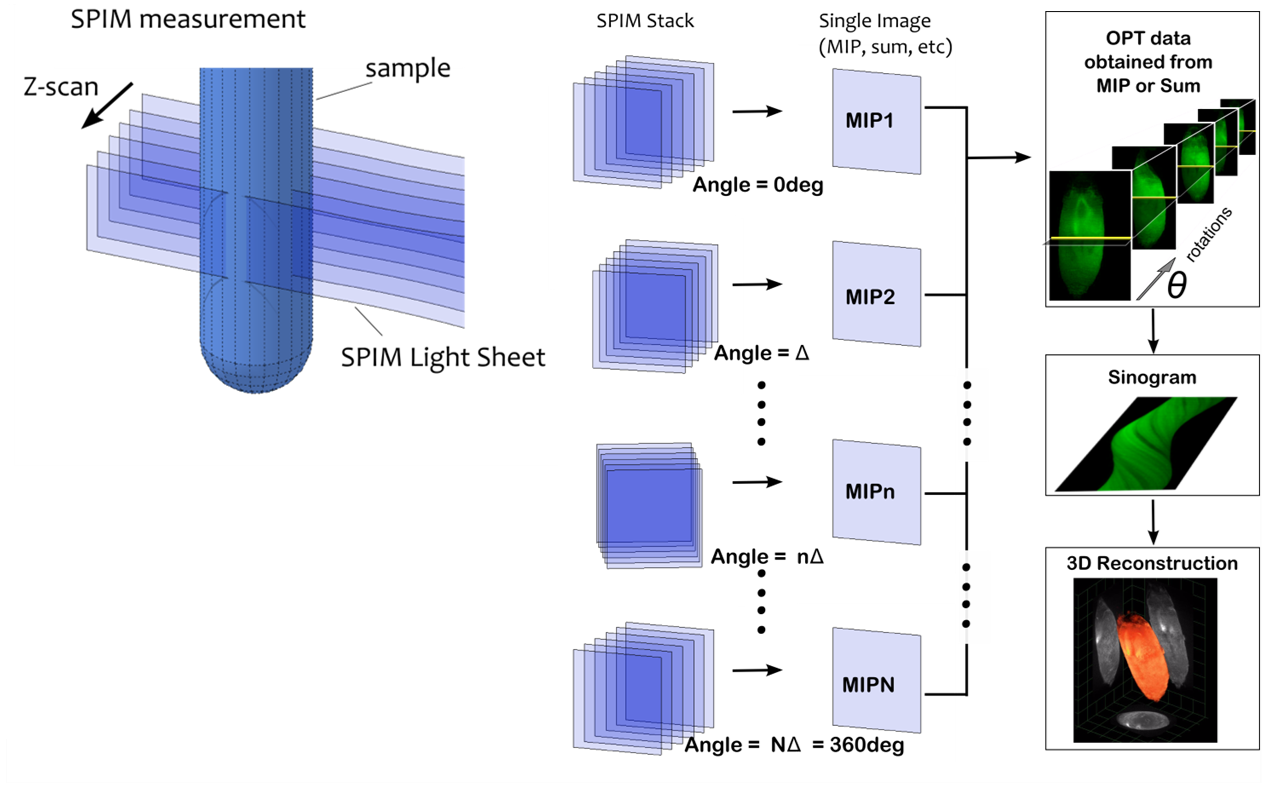
A well-established strategy to improve axial resolution in SPIM is multi-view acquisition. By rotating the sample and acquiring datasets from different angles, axial information from one view becomes lateral information in another. Computational fusion of these views leads to a more isotropic effective resolution
- Two-angle SPIM already provides a noticeable improvement by partially compensating for axial elongation.
- Four-angle SPIM further reduces directional bias and improves structural fidelity.
However, even with a small number of views, residual anisotropy remains, particularly in large or optically complex samples
Isotropic resolution with Statistical Projection Optical Tomography (SPOT)
True isotropic resolution requires moving beyond a limited number of discrete views. By integrating SPIM illumination with high-density angular acquisition typical of OPT, our system overcomes the intrinsic axial resolution limitation of conventional light-sheet microscopy. The result is true isotropic 3D fluorescence imaging, where resolution is no longer dependent on the imaging axis.
This hybrid SPIM–OPT approach is particularly powerful for:
- Whole-organ and whole-organism imaging
- Cleared tissues
- Quantitative morphometric analysis
High-accuracy 3D reconstructions for biology and biomedical research